Blog
A day in Paestum: Greek temples by train from Salerno
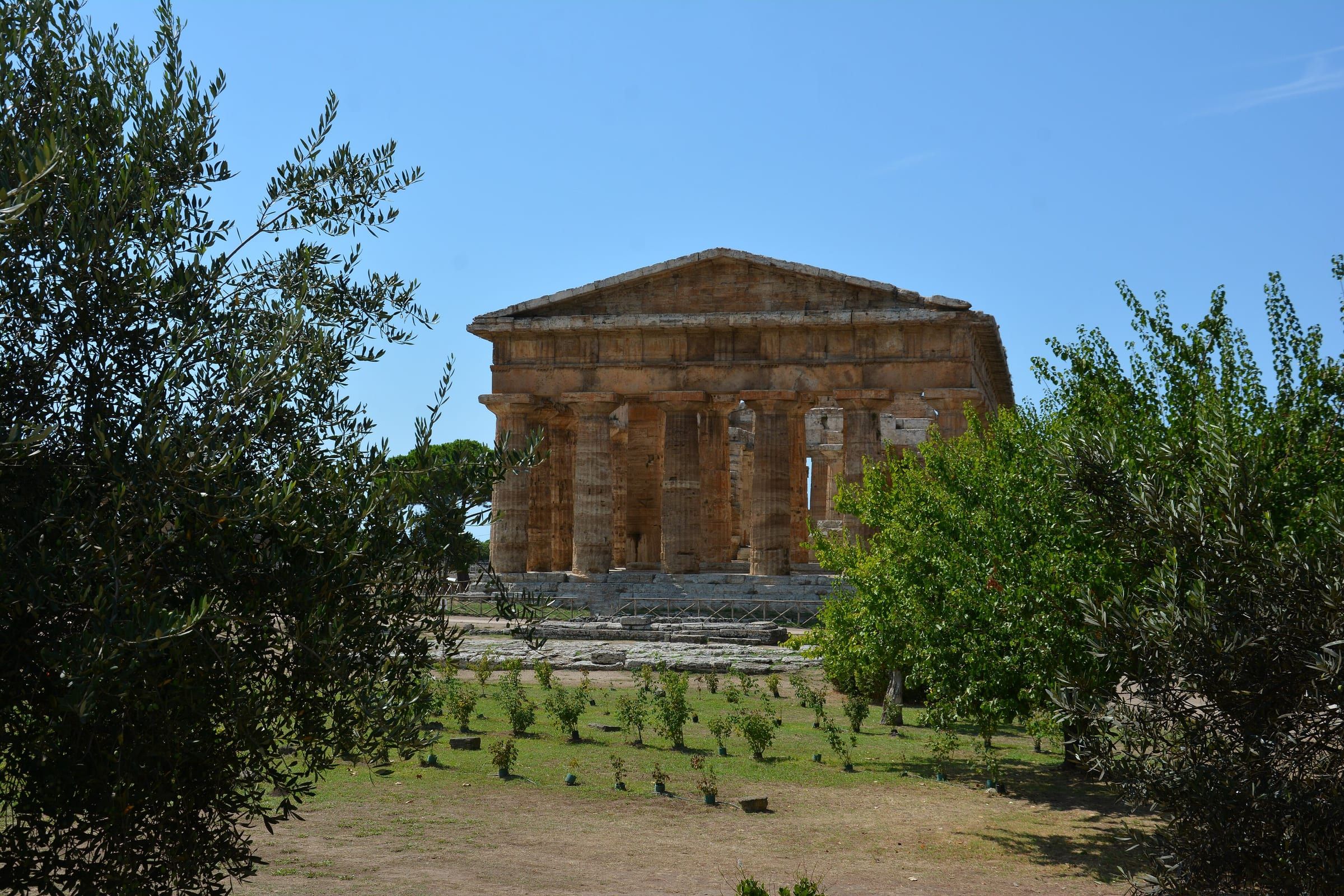
Photo: Mentnafunangann, CC BY-SA 4.0, via Wikimedia Commons, resized
Before it was called Paestum, this city was Poseidonia, the city of Poseidon. Greek settlers from Sybaris founded it at the beginning of the 6th century BC, and the Latin name only arrived in 273 BC, when Rome set up a colony here. Today its temples are a train ride from Salerno, no need to hire a car, and the trip fits comfortably into a single day.
Getting there
Paestum station is on the railway line that runs south from Salerno towards Calabria, and it's served by regional trains. From the station you enter the ancient city through Porta Sirena, one of the gates in the walls, and after a walk of about fifteen minutes you reach the temples and the museum. If you prefer, there's also a bus service linked to the train that takes you from the station to the archaeological park.
Timetables and tickets change, so check the Trenitalia website and the park's official site before you go.
The temples
The three great Doric temples date from the 6th and 5th centuries BC and show, side by side, three different stages of Greek architecture in Italy. The Treccani encyclopaedia describes them as the best-preserved complex in Magna Graecia.
The names we use for them, though, partly come from old misreadings. The building everyone calls the "Basilica" was actually a temple to Hera. The so-called "Temple of Neptune" is also considered by scholars to be a temple of Hera. And the "Temple of Ceres" is identified as a temple of Athena. Knowing this makes reading the signs a lot more fun.
The walls
Paestum's walls date from the 4th century BC, with a pentagonal layout and four gates. If you have time left, walk a stretch of them: it gives you a real sense of how big the city was.
The museum and the Diver
Don't skip the National Archaeological Museum. It holds the Tomb of the Diver, a painted tomb dating from 480-470 BC, named after the figure of a man diving that appears on its cover slab. The museum also keeps the metopes from the sanctuary of Hera at the mouth of the River Sele: stone panels carved with mythological scenes in the 6th century BC.
A World Heritage Site
Since 1998 Paestum has been on the UNESCO World Heritage list, together with Velia, the ancient Elea, which today is managed by the same archaeological park.
Practical tips
- Start early: between temples, walls and museum, the day fills up fast.
- Water and a hat in the warmer months: there's little shade in the archaeological area.
- Comfortable shoes: you'll walk a lot, often on uneven ground.
In the evening you take the same line back to Salerno, and from our B&B in the old town the station is within walking distance.
Sources
- Archaeological Parks of Paestum and Velia, official website (Italian Ministry of Culture)
- Italian Ministry of Culture, "Parchi archeologici di Paestum e Velia, Museo archeologico nazionale"
- Enciclopedia Treccani, "Paestum" (in Italian)
- Trenitalia, "Paestum Link" (in Italian)
- Wikipedia, "Paestum railway station"